An Egyptian farmer tending to his cucumbers stumbled upon an ancient stone that led archaeologists to a significant discovery. The stone, found in a greenhouse on the farmer's property in the village of Behbeit El-Hagar, was inscribed with hieroglyphics that caught the attention of local archaeological authorities.
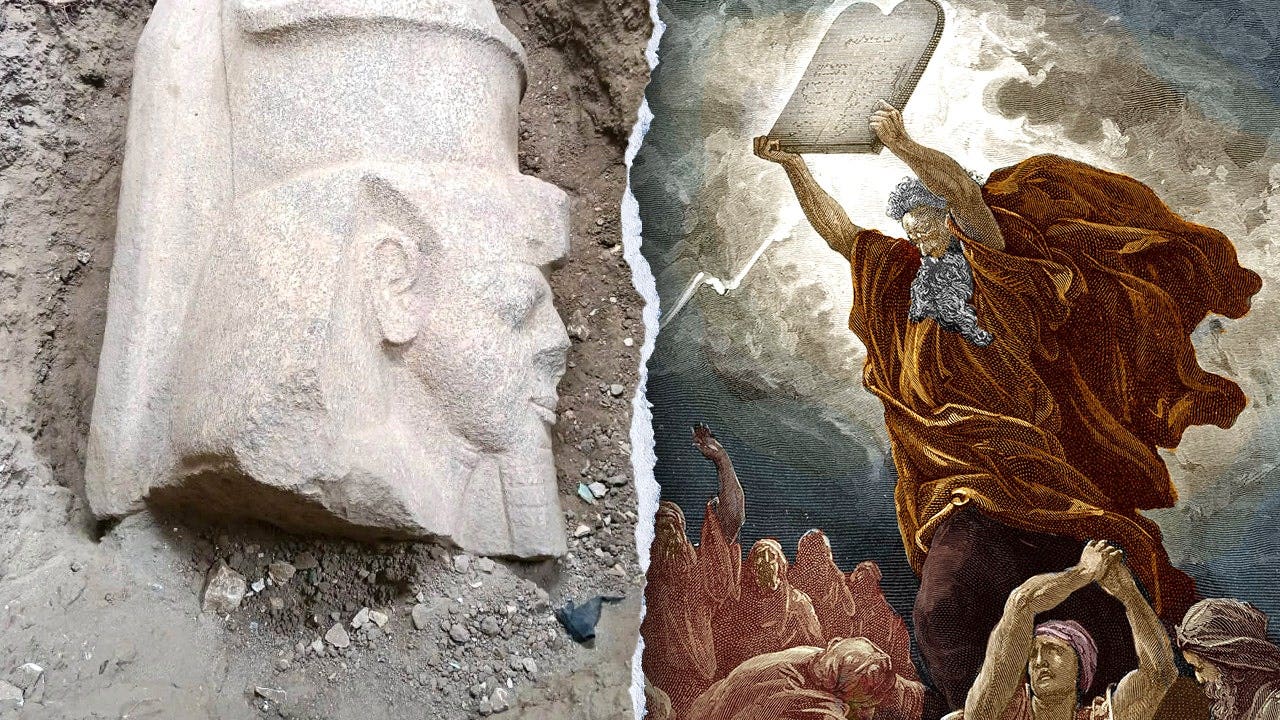
After inspecting the site, the authorities uncovered the remains of two colossal statues believed to depict Ramses II, the pharaoh who ruled Ancient Egypt during the New Kingdom period. One of the statues has been identified as depicting the king, while the other is also believed to represent Ramses II. The mission also discovered a pink granite block bearing hieroglyphic inscriptions that include several of the king's royal titles.
Ramses II, who was born in 1303 B.C., was among the most powerful and influential pharaohs of Ancient Egypt's New Kingdom period. Some scholars have suggested that Ramses II was the pharaoh described in the Book of Exodus, although the Old Testament does not identify the ruler by name.
The first statue features a colossal head of Ramses II measuring more than 5 feet tall. The pharaoh is depicted wearing a double crown, symbolizing the unification of Upper and Lower Egypt. Archaeologists estimate the original statue, including its base, may have stood nearly 28 feet tall. The second statue, also believed to depict Ramses II, measures nearly 8 feet long and is missing its legs and base.
Excavations and archaeological studies at the site are ongoing, officials said, and are expected to provide a clearer understanding of the two statues, the area's history, and its architectural development during ancient Egyptian times.
NTC Report coverage is based on reporting from the original publisher.
View original reporting →